
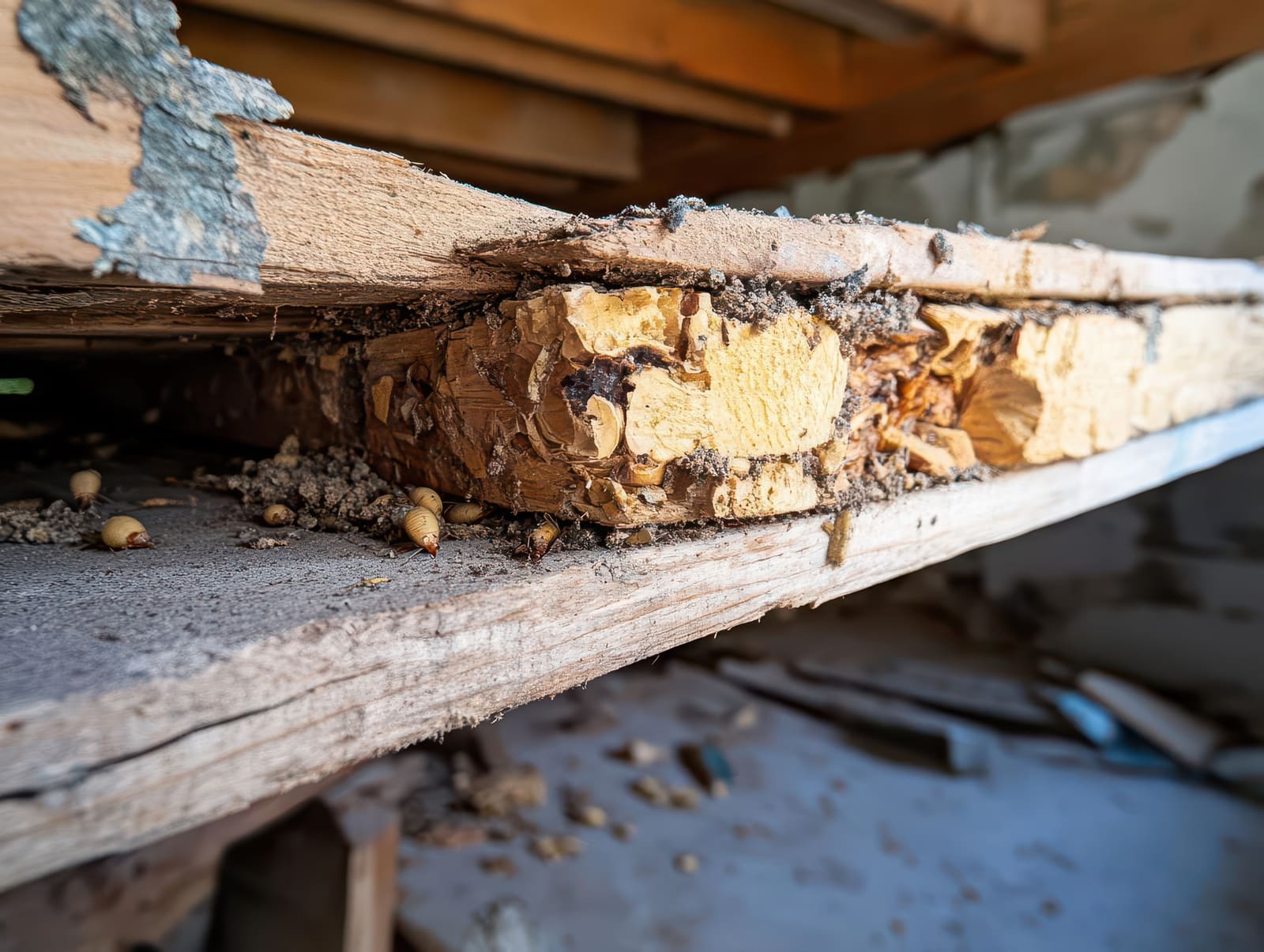
Pest control for termites gets urgent right after the first real rain of the season, because that first rainfall is one of the most reliable triggers for a subterranean termite swarm in the Inland Empire. A mature colony sends out winged reproductives, called alates or swarmers, to start new colonies elsewhere, and the softened, moisture-rich soil that follows the season’s first storm gives them ideal conditions to emerge and disperse. Homeowners who know what to look for in that window have a real chance to catch a new colony before it ever reaches the framing of their home, which is exactly why the days following that first rain deserve more attention than most people give them. Here is what a termite swarm actually looks like, how to tell it apart from an ordinary flying ant, and why an inspection triggered by discarded wings on a windowsill is one of the most useful calls a homeowner can make all year.
Why the First Rain Triggers a Swarm
Subterranean termites need consistent soil moisture to survive, and for most of a dry Southern California summer, the ground around a typical Riverside property simply is not wet enough to support a mass emergence of winged reproductives. The first significant rain changes that almost overnight. Softened, moisture-rich soil makes it easier for a mature colony to send swarmers up and out, and the timing is not a coincidence. Colonies time this dispersal event around conditions that give the new reproductives the best possible chance of surviving long enough to found a new colony somewhere else.
This is why termite swarm activity in this region tends to cluster around the same general window every year rather than showing up randomly throughout the summer. A property that has gone all season without any visible termite activity can suddenly show clear signs within days of that first storm, which catches a lot of homeowners off guard simply because nothing seemed to be happening the week before.
What a Termite Swarm Actually Looks Like
A termite swarm involves winged reproductive termites emerging from an established colony, often in surprisingly large numbers over a short window, sometimes just an hour or two around dusk. Swarmers are drawn to light, so they often show up near windows, porch lights, or other bright fixtures shortly after emerging. Once they have paired off and found a suitable spot, the wings are shed, which is why the most common physical evidence left behind is not the termites themselves but a scattering of discarded, uniform-length wings on a windowsill, patio, or entryway.
Because the actual swarm event is often brief and can happen while a family is asleep or away from home, the wings left behind are frequently the only sign anyone ever notices. They are easy to sweep up and forget about, but they are worth photographing and mentioning to a technician even after they have already been cleaned up, since that detail alone can be enough to justify a closer inspection of the property.
Termite Swarmers vs. Flying Ants: Telling Them Apart
Termite swarmers get mistaken for flying ants constantly, and the confusion is understandable, since both are winged insects that tend to emerge around the same time of year in similar numbers. A few physical differences separate them reliably once someone knows to look. Termite swarmers have two pairs of wings that are roughly equal in length, while flying ants have a longer front pair and a noticeably shorter back pair. Termite bodies are straight-sided with a thick waist, while ants have a distinctly pinched, narrow waist between the thorax and abdomen. Antennae are another giveaway: termite antennae are straight, while ant antennae are bent at a clear angle, almost like an elbow.
None of these differences are especially easy to spot from across a room, particularly with insects that are already gone by the time anyone gets a close look. This is exactly why a homeowner who sees a small swarm or finds a pile of discarded wings should treat it as a reasonable trigger for a professional inspection rather than trying to make a confident identification from memory. Getting the identification wrong in either direction has real consequences, either dismissing a genuine termite swarm as harmless flying ants, or spending money addressing an ant swarm that never needed termite-specific treatment in the first place.
Timing offers a small additional clue, though not a definitive one. Termite swarms in this region tend to cluster tightly around the days immediately following a significant rain event, while flying ant swarms are somewhat less tied to a single specific trigger and can show up across a broader window of warm weather. This is a useful piece of context to keep in mind, but it should never replace an actual inspection, since both insects are capable of swarming outside their typical pattern under the right conditions.
Found Discarded Wings Near a Window?
Get a free inspection before assuming it was just flying ants.
Request a Free Inspection »Other Signs Worth Checking Alongside a Swarm
A swarm or a pile of discarded wings is rarely the only sign present on a property with an active termite issue, even if it is the most visible one. Mud tubes, narrow tunnels built from soil, wood particles, and termite saliva, are often found along foundation walls, piers, or crawl space supports, and they are worth checking for at the same time a swarm is reported. An old, dry, crumbling mud tube still matters during an inspection, since it confirms termites have had access to that specific point at some point, even if current activity needs to be separately confirmed.
Hollow-sounding wood, when tapped, and small piles of what look like wood-colored pellets, termite droppings called frass, are two more signs worth a look around window frames, baseboards, and any exposed wood framing in a garage or crawl space. None of these signs guarantee an active infestation on their own, but any one of them showing up around the same time as a swarm is a reasonable trigger for a full inspection rather than waiting for damage to become visible from inside the home.
It’s worth being direct about the limits of a visual check. Wood-to-soil contact points, a fence post set directly into soil, siding installed too close to grade, a low deck support, create a potential access point that bypasses the need for a mud tube entirely, and these direct contact points are often easier for termites to exploit than building a tube up an exposed foundation wall. A homeowner doing their own walk-around after a swarm is likely to check the obvious spots, foundation walls and visible wood, while missing the less obvious wood-to-soil contact points that a trained technician knows to look for specifically.
Why This Timing Window Actually Matters for Prevention
A termite swarm represents a colony trying to expand, not necessarily a colony that has already reached a structure. Catching a swarm event near a property, even one that has not yet caused visible damage, is one of the earliest possible warning signs a homeowner can act on. Waiting until wood damage or sagging floors show up inside the home means the colony has likely been established and feeding for a considerable amount of time already.
This is also why the days right after the season’s first rain are worth a bit of extra attention around a property’s exterior. A homeowner who checks windowsills, porch areas, and foundation walls for a week or two following that first storm has a meaningfully better chance of catching early activity than someone who only thinks about termites once a year during a scheduled inspection. It costs nothing but a few minutes of attention, and it is one of the only times all year when a colony is actively announcing its presence rather than staying hidden underground or inside a wall void.
Reactive Inspections vs. a Standing Annual Plan
A swarm-triggered inspection is valuable, but it is still a reactive response to a specific event rather than a full prevention strategy. Termite risk on a property is shaped by year-round factors, irrigation habits, foundation type, wood-to-soil contact points, that do not go away once a swarm season passes. A property that only gets checked when wings show up on a windowsill is still going uninspected for the rest of the year, which leaves plenty of room for a colony to establish itself quietly between visible events.
This is part of why an annual inspection schedule, separate from any swarm-triggered visit, tends to catch more overall. A yearly cadence lines up well with how landscaping and irrigation setups change over time. A sprinkler head that got bumped out of alignment, a new planter bed installed against a wall, or a fence repair that left a post in direct soil contact can all shift a property’s risk profile within a single year, and a swarm event is just one of several ways that shifting risk becomes visible. The rest of the time, it is quietly building underground.
How Akela Approaches Termite Control
We bring state-of-the-art technology together with a deep understanding of termite behavior, using an integrated pest management approach that combines bait systems, soil treatments, and physical barriers rather than relying on one method alone. Every visit starts with a thorough inspection using specialized equipment to treat infestations at the source, not just the visible signs. Emergency termite services are available, and every estimate is free before any work begins, with no contracts required, ever. A technician who responds to a swarm report treats it the same way as any other inspection trigger: identifying the species involved, checking for mud tubes and wood-to-soil contact points, and building a treatment plan around what is actually found rather than assuming the worst from a handful of wings on a windowsill.
Because moisture and irrigation habits play such a large role in termite risk generally, a swarm-triggered inspection is also a useful opportunity to check for cockroach activity drawn to the same damp conditions near a foundation, since both issues often share a root cause. It is also worth confirming that gnaw damage in a garage or attic is not being mistaken for termite activity, since rodent damage can sometimes look similar to an untrained eye until someone actually inspects the wood up close.
See Our Full Termite Control Services
Get a free estimate and a real inspection of your foundation, moisture points, and wood-to-soil contact.
See Termite Control »The first rain of the season is not just a relief from the summer heat. It is one of the more reliable windows all year to catch termite activity before it turns into a structural repair bill, and a few discarded wings on a windowsill are worth far more attention than most homeowners give them.
Frequently Asked Questions
Why does termite swarming happen right after the first rain?
Subterranean termites need soil moisture to survive, and the softened, moisture-rich soil after the season’s first rain gives winged reproductives ideal conditions to emerge and disperse to start new colonies.
How can I tell a termite swarmer from a flying ant?
Termite swarmers have two pairs of equal-length wings, a straight, thick waist, and straight antennae. Flying ants have a longer front wing pair, a pinched waist, and bent, elbow-shaped antennae.
I found discarded wings but already swept them up. Does that matter?
Yes. Even after the wings are cleaned up, mentioning what you saw, and photographing them if possible, gives a technician a useful reason to inspect the property closely for other signs of activity.
Does a swarm near my house mean termites are already inside?
Not necessarily. A swarm represents a colony trying to expand to a new location, which may or may not be your structure. It’s still one of the earliest warning signs available, which is why it’s worth an inspection rather than assuming the worst or ignoring it entirely.
What other signs should I check for around the same time as a swarm?
Mud tubes along foundation walls or piers, hollow-sounding wood when tapped, and small pellet-like droppings called frass are all worth checking alongside any swarm activity or discarded wings you find.