
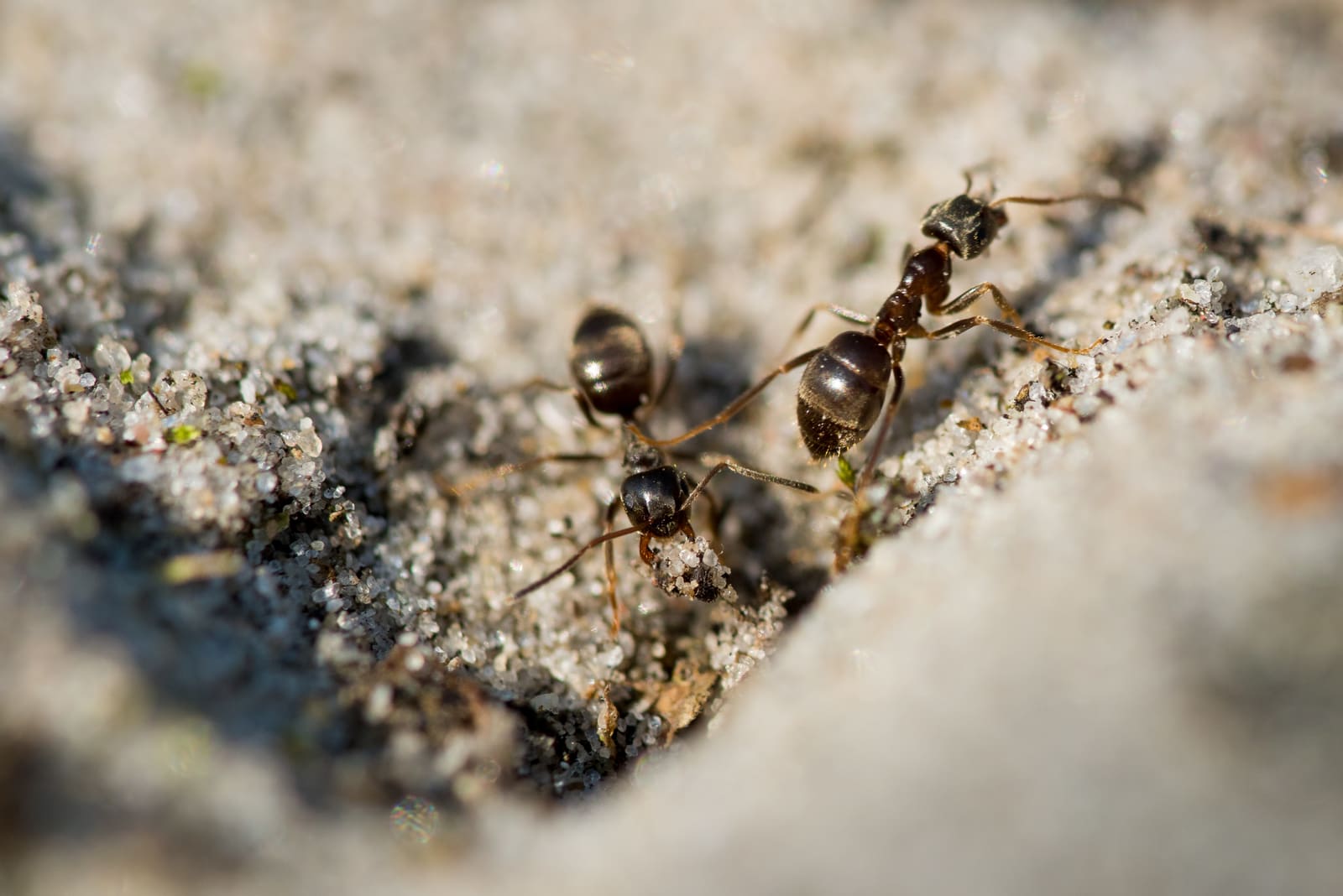
Ant control in Riverside CA almost always comes back to one species more than any other: the Argentine ant. If a backyard has developed a steady trail of small, fast-moving ants marching across a patio or up a foundation wall, Argentine ants are the overwhelming statistical favorite, well ahead of fire ants, carpenter ants, or any other species that gets more national attention. Argentine ants thrive in exactly the kind of irrigated, moisture-adjacent landscaping that defines most Riverside backyards, and understanding why this specific species has taken over local yards is what actually leads to a treatment plan that works. Here is why Argentine ants dominate here, how to tell them apart from the other ants they get confused with, why one treatment sometimes isn’t enough to fully knock the problem down, and what a real ant control approach looks like once the species is confirmed.
Why Argentine Ants Specifically Dominate Riverside Yards
Argentine ants nest in soil, and they strongly favor locations near consistent moisture, sprinkler heads, mulch beds, potted plants that get watered regularly, and the edges of irrigated lawns. Riverside’s landscaping style, heavily reliant on irrigation to keep yards green through a long, dry growing season, creates almost ideal nesting conditions across a huge share of the city’s residential backyards. A yard with a working sprinkler system essentially advertises itself to Argentine ants as prime real estate, whether or not the homeowner realizes it, and the effect compounds year over year as an established colony expands into every corner of a yard that offers the conditions it needs.
This is different from how fire ants or many carpenter ant populations establish themselves, which tend to be tied more to specific structural or environmental triggers rather than general landscaping moisture. Argentine ants, by contrast, thrive across an enormous range of ordinary residential conditions, which is exactly why they show up so consistently across Riverside neighborhoods regardless of a property’s specific age, construction, or landscaping style, as long as regular irrigation is part of the picture.
Native to South America, Argentine ants were introduced to the United States over a century ago and have since displaced many native ant species across much of the warmer, irrigated parts of the country, including Southern California. Part of what makes them such effective competitors is their tolerance for a wide range of conditions and their cooperative colony structure, which allows them to out-compete native species that defend smaller, more isolated territories. In a region like Riverside, where irrigation keeps soil consistently workable for a large part of the year, that competitive advantage translates into near-total dominance of the local backyard ant population.
Telling Argentine Ants Apart From Other Species
Argentine ants are small and light to dark brown, and one of their most identifiable traits is behavioral rather than physical: they move in dense, fast-moving trails rather than the more scattered, individual foraging pattern a species like the carpenter ant uses. A trail of Argentine ants tends to look like a steady, continuous stream rather than a handful of ants wandering independently, and that trail can stretch a surprisingly long way from the nest to a food source indoors.
This is a useful distinction from the two other ants most commonly confused with Argentine ants in this region. Carpenter ants are noticeably larger, often close to half an inch long, with a single node between the thorax and abdomen and a smoothly rounded top on the thorax, and they’re commonly black, though some have a reddish tint. Pavement ants are small and dark like Argentine ants but typically nest under slabs, sidewalks, and driveways rather than in soil near moisture, which makes finding them outdoors near hardscaping fairly normal and not necessarily a sign of an indoor problem. Argentine ants specifically nest in soil, often visibly near a sprinkler head or a mulch bed, which is one of the more reliable field clues once a homeowner knows to look for it.
Size alone can be misleading without a reference point, so it helps to compare all three species side by side when possible. Carpenter ants are large enough to be identified without magnification in most cases, while Argentine ants and pavement ants require a closer look and, ideally, an assessment of where the trail is actually leading. A trail heading toward a soil-based nest near a sprinkler or mulch bed points toward Argentine ants, while a trail emerging from a crack in a driveway or the seam of a concrete slab points toward pavement ants instead.
Not Sure Which Ant You’re Dealing With?
A quick inspection confirms the species and where the colony is actually nesting.
Request a Free Inspection »Why Argentine Ant Colonies Are So Hard to Fully Knock Down
Argentine ants have a colony structure that makes them particularly resilient compared to many other backyard ant species: rather than a single queen defending one central nest, Argentine ant colonies frequently include multiple queens spread across interconnected nesting sites, sometimes stretching across several properties in a neighborhood. This structure means treating one visible trail or one obvious nest often fails to address the broader network the colony is actually operating from.
This also explains why a homeowner who successfully treats a trail on their own patio sometimes sees the same ants reappear within a few weeks, having simply rerouted from a different, untreated portion of the same interconnected colony rather than truly returning from nothing. Addressing an Argentine ant problem effectively usually requires identifying multiple nesting locations and treatment points, not just the single trail that happens to be visible on a kitchen counter.
This multi-queen structure also means Argentine ant colonies can be genuinely large in scale, sometimes spanning multiple properties in a neighborhood rather than staying contained to a single yard. A homeowner who treats their own property thoroughly can still see ant pressure return if an untreated portion of the same colony network remains active next door, which is part of why persistent, professionally managed treatment tends to outperform a single DIY spray applied to whatever trail happens to be visible that week.
Nuisance Pest, Not a Structural One, But Still Worth Addressing
Argentine ants are considered a nuisance pest rather than a structural threat, since unlike carpenter ants, they aren’t looking to nest inside wood framing or cause damage to a home’s structure. Once a food source or entry point is addressed, an Argentine ant trail is generally manageable, which is meaningfully different from the more serious, structure-focused approach a genuine carpenter ant colony requires.
That distinction doesn’t make Argentine ants harmless to ignore, though. A large, well-established colony can produce a near-constant nuisance presence across a patio, kitchen, or outdoor entertaining area throughout the warm season, and their preference for moving in dense trails toward food sources means an unaddressed kitchen entry point can turn into a daily annoyance rather than an occasional one. The species being non-structural just means the urgency is different, not that the problem resolves itself.
It’s also worth noting that a persistent Argentine ant presence can sometimes mask or get confused with the early signs of a carpenter ant problem, since both species can show up around the same general areas of a home. Because the treatment approach and urgency differ so much between the two, correctly identifying which species is actually present, rather than assuming every ant sighting is the same low-stakes nuisance, is worth the extra step of a proper inspection.
The Role Irrigation Habits Play in an Ongoing Problem
Because Argentine ants are drawn specifically to moisture-adjacent nesting sites, irrigation habits shape ant pressure on a property just as directly as they shape termite risk or mosquito breeding. A sprinkler head that sprays consistently against a planter bed, a drip irrigation line with a slow leak, or a mulch bed that stays damp well after watering are all conditions that make a specific spot in a yard more attractive to an Argentine ant colony looking to establish a new nesting site.
This means two neighboring properties with otherwise similar landscaping can have very different ant pressure depending on small differences in how each yard is irrigated. A property with sprinklers angled slightly away from planter beds, and mulch kept at a reasonable depth rather than piled thick and consistently damp, tends to offer less inviting real estate to a colony looking to expand, even if an established colony is already active somewhere nearby in the neighborhood.
Seasonal irrigation adjustments matter too. Many Riverside homeowners increase watering frequency through the hottest stretch of summer to keep lawns and plants alive, which coincides with the same period when Argentine ant activity tends to peak. This overlap isn’t a coincidence: the additional moisture from more frequent watering creates more attractive nesting conditions right as ant colonies are most active and expanding their foraging range, which is part of why summer often feels like the worst stretch for backyard ant trails specifically.
How Akela Approaches Ant Control
We offer ant control solutions that are effective, eco-friendly, and safe for families and pets, using technicians equipped to track down ant colonies and eliminate them at the source rather than simply treating a visible trail. Whether it’s an Argentine ant colony spread across interconnected nesting sites, a carpenter ant colony working through structural wood, or a pavement ant nesting under a walkway, every treatment plan starts with identifying the species and understanding the specific conditions on that property. Every estimate is free, and there are no contracts required, ever, and treatment is built around actually locating the colony’s nesting sites rather than repeatedly knocking down whatever trail happens to be visible that week.
Because Argentine ants nest near the same moisture-adjacent conditions that draw other pests, an ant-focused inspection is also a useful opportunity to check for mosquito breeding sites in the same irrigated areas, since both pests are drawn to the consistent moisture that Riverside’s landscaping style tends to create throughout a yard, particularly around sprinkler heads, mulch beds, and low spots where water collects after each watering cycle.
See Our Full Ant Control Services
Get a free estimate and a real inspection to identify the species and locate the colony.
See Ant Control »Argentine ants aren’t the ant species with the scariest reputation nationally, but they are, by a wide margin, the one actually taking over Riverside backyards, and understanding why irrigation and landscaping habits favor them so heavily is what separates an effective treatment plan from one that just knocks down a trail for a few weeks before it reappears somewhere else in the yard, right back where it started.
Frequently Asked Questions
Why are Argentine ants so common in Riverside specifically?
Argentine ants nest in soil near consistent moisture, and Riverside’s irrigation-dependent landscaping creates ideal nesting conditions across most residential yards, giving this species a major advantage over other ants in the region.
How can I tell Argentine ants apart from carpenter ants or pavement ants?
Argentine ants are small and move in dense, fast-moving trails, nesting in soil near moisture. Carpenter ants are noticeably larger with a single node and rounded thorax. Pavement ants are small like Argentine ants but nest under slabs and sidewalks rather than in soil near irrigation.
Why does treating one ant trail sometimes not solve the problem?
Argentine ant colonies often have multiple queens across interconnected nesting sites. Treating one visible trail can leave the broader colony network intact, allowing ants to reroute and reappear from an untreated nesting site nearby.
Are Argentine ants dangerous to my home’s structure?
No. Argentine ants are a nuisance pest rather than a structural one, unlike carpenter ants, which target wood framing. They can still be a persistent annoyance around food sources and outdoor living areas if left unaddressed.
Can I reduce Argentine ant activity through irrigation changes?
Adjusting sprinklers away from planter beds and keeping mulch at a reasonable depth can make a yard less attractive to a new colony, though an already-established colony typically still needs professional treatment to fully address.