
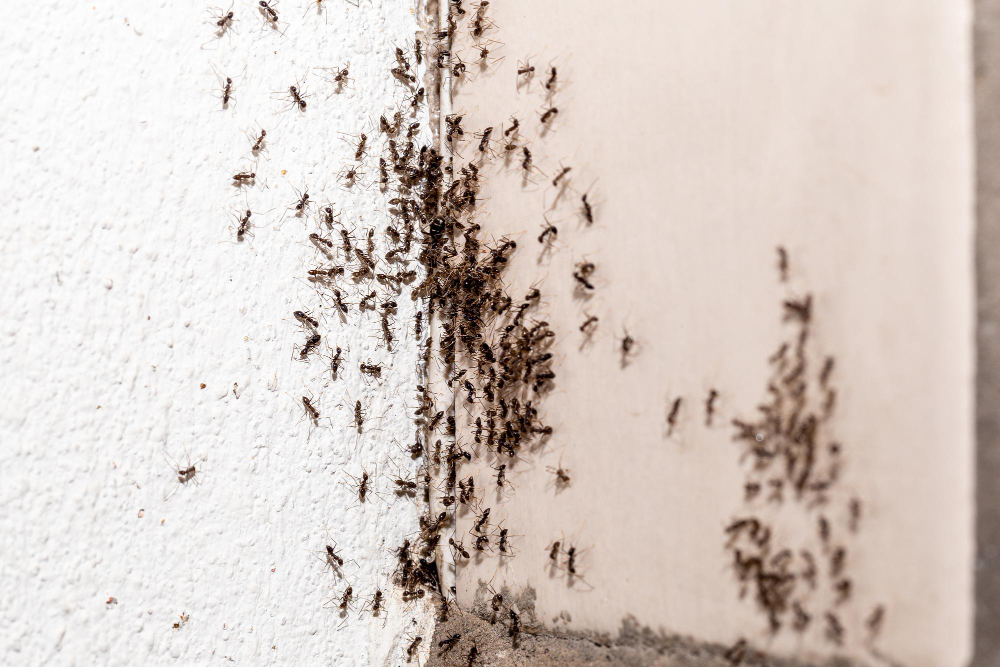
If you’ve been brushing large black ants off the kitchen counter for a couple of weeks and assumed they were just another nuisance ant, it’s worth a second look before they cost you a wall. Carpenter ant pest control is a different job than regular ant control because carpenter ants don’t just wander through a house looking for crumbs. They hollow out wood to build a nest, and they’ll keep expanding that nest as long as it stays undisturbed. The ants you see on the counter are almost always a small fraction of the colony; the rest are working somewhere you can’t see them. That’s why misidentifying a carpenter ant as an Argentine or pavement ant, both of which we also treat regularly, can mean weeks of wasted spray while the real problem keeps growing behind the drywall. Here’s how to tell the difference, what the warning signs actually look like, and what it takes to deal with a carpenter ant colony instead of just the ants you can see.
Why the Ants on Your Counter Might Not Be “Just Ants”
Most ant problems in Southern California homes come down to one of three species we treat constantly: Argentine ants, carpenter ants, and pavement ants. Argentine and pavement ants are nuisance pests. They’re annoying, they trail across countertops looking for food, and once the food source or entry point is addressed, they’re usually manageable. Carpenter ants are a different category entirely, because their goal isn’t your pantry. It’s the wood framing your house is built from.
A few carpenter ants on the counter doesn’t necessarily mean a nest is already established indoors. Foraging workers travel a good distance from the colony looking for food and moisture, so seeing them inside doesn’t automatically confirm where the nest actually is. But it’s also not something to wait out. Carpenter ants that keep showing up in the same spot, especially near a window, a bathroom, or anywhere wood has been exposed to moisture, are worth taking seriously before they finish deciding your house is a good place to settle down.
Carpenter Ants vs Argentine Ants vs Pavement Ants: Telling Them Apart
The easiest way to start narrowing down which ant you’re dealing with is size and color. Carpenter ants are noticeably larger than the other two, often close to half an inch long, with a single node between the thorax and abdomen and a smoothly rounded top on the thorax. They’re commonly black, though some have a reddish tint to the body. Argentine ants are much smaller and light to dark brown, and they tend to move in dense, fast-moving trails rather than the more scattered, individual foraging pattern carpenter ants use. Pavement ants are small and dark as well, usually found nesting under slabs, sidewalks, and driveways rather than inside wall framing.
Behavior is often the bigger tell. Argentine and pavement ants are drawn to food, especially sugars and grease, and they’ll follow a scent trail straight to it. Carpenter ants forage more individually and are especially active at night, which is part of why a lot of homeowners never actually see them until the colony is already well established.
Location matters too. Pavement ants get their name for a reason. They typically nest under slabs, sidewalks, driveways, and along foundation edges, so finding them outdoors near hardscaping is fairly normal and doesn’t necessarily point to an indoor problem. Argentine ants nest in soil, often near moisture sources like sprinkler heads or mulch beds, and their trails can stretch a surprisingly long way from the nest to a food source indoors. Carpenter ants are the one species on this list that’s genuinely looking for a place to build inside your home’s structure, which is exactly why they get treated differently from the start.
The Sign Most Homeowners Miss: Frass
Carpenter ants don’t eat wood the way termites do. They chew through it and push the debris out of the nest, and what gets pushed out is called frass, a mixture of fine wood shavings and discarded insect parts. Frass piles tend to show up in specific spots: under window sills, near door frames, along baseboards, or anywhere a small opening in the wood lines up with an active gallery inside. A pile of what looks like sawdust in a spot where no one has been sawing anything is one of the more reliable signs that a colony is active nearby.
Other signs include faint rustling sounds inside walls, especially at night when foraging activity picks up, and discarded wings on windowsills during swarming season, when a mature colony sends out reproductive ants to start new colonies elsewhere. Swarmer wings are often mistaken for flying ant activity in general or even confused with termite swarms, which is exactly why a physical inspection matters more than guessing from a few loose wings on a sill.
Why Carpenter Ants Target Wood (and Why That’s a Problem)
Carpenter ants prefer wood that’s already softened by moisture, which is why a nest often starts near a leaky window, a damp crawl space, or wood that’s had water damage at some point. Once established, though, the colony isn’t limited to the damaged wood. Over time it can expand into structurally sound framing nearby, hollowing out galleries as it grows. A colony left alone long enough can weaken the wood it’s tunneling through, which is a very different outcome than a trail of Argentine ants on the kitchen counter.
This is the core reason misidentifying carpenter ants costs homeowners time. Treating the visible trail with a store-bought spray might knock down the ants you can see without ever touching the nest, which means the colony keeps growing in the wall the whole time you think the problem is handled.
Not Sure Which Ant You’re Dealing With?
Get a free estimate and a real inspection to identify the species and locate the nest, not just a guess from a photo.
Request Your Free Estimate »Why a Kitchen Spray Won’t Fix a Carpenter Ant Problem
Most over-the-counter ant sprays are built for the ants that are out in the open, which works reasonably well for Argentine or pavement ants trailing across a counter. Carpenter ants are a different challenge because the workers you see represent a portion of the colony, and the nest itself, along with the queen, stays protected inside the wood. Spraying the ants on the counter does nothing to the colony producing more of them.
It’s the same underlying problem we see with a lot of DIY pest control attempts: treating what’s visible instead of addressing where the pest actually lives. With carpenter ants specifically, that gap matters more than usual, since the “nest” is inside your home’s structure rather than somewhere in the yard.
What Professional Carpenter Ant Treatment Actually Involves
Our approach to ant control uses integrated pest management, which for carpenter ants means a few distinct steps rather than a single spray:
- Inspection and identification to confirm the species and, where possible, locate the nest or narrow down likely areas based on frass, sounds, and moisture conditions
- Addressing the underlying conditions that attracted the colony in the first place, including moisture sources, entry points, and any wood that’s been softened by water damage
- Non-chemical methods such as barriers, traps, and targeted removal where appropriate
- Targeted, eco-friendly treatment applied directly to the colony and its access points as a last resort, rather than broad spraying throughout the home
Because carpenter ants are drawn to moisture-damaged wood, a big part of the visit is often about identifying and flagging the conditions that made a spot attractive to them in the first place. Fixing a leak or improving drainage near the foundation can matter as much as the treatment itself, since a colony removed from one section of softened wood will simply look for the next damp spot if the underlying moisture problem never gets addressed.
Treatment timing matters too. Carpenter ant colonies are easiest to deal with before they’ve had the chance to establish satellite nests, which some species will do once the original colony gets large enough. A satellite nest doesn’t need its own queen right away, so a colony that’s already split into more than one location can look like it’s been eliminated when only part of it actually was. That’s part of why we treat this as a property-wide inspection rather than a single spot treatment.
When to Call Immediately vs When to Monitor
A few ants spotted once near an open window, especially during warm weather, isn’t necessarily cause for alarm. What should move carpenter ants up the priority list:
- The same large black ants showing up repeatedly in the same area of the house over several days
- Frass piles under a window sill, along a baseboard, or near a door frame
- Discarded wings on a windowsill, particularly if there’s no obvious source nearby
- Faint rustling or ticking sounds coming from inside a wall, especially at night
- Known moisture damage or a past leak in the area where ants keep appearing
Any one of these on its own is worth a look. A couple of them together are worth a call.
How Akela Approaches Carpenter Ant Control
We’ve spent years treating ant problems across Riverside and the surrounding areas, and carpenter ants get a different approach from Argentine or pavement ants from the moment we walk the property. Every treatment plan starts with identifying the species and understanding the specific conditions on that property, not a one-size-fits-all spray. The products we use are effective, eco-friendly, and safe for families and pets, and every estimate is free before any work begins.
If ants aren’t the only concern on the property, the same visit is a good time to flag anything else worth watching. A property already dealing with cockroach activity or rodent signs, for example, often benefits from one team handling all of it under a single ongoing maintenance plan instead of separate calls for every pest that shows up.
Get $150 Off Your First Service
New customers save $150 on their initial ant pest control visit. No contracts required, ever.
Claim Your Discount »An ant trail on the counter is easy to dismiss as background noise in a Southern California home. With carpenter ants specifically, that assumption is the expensive one. Knowing what to look for, and getting a real inspection instead of guessing, is what keeps a few ants on the counter from turning into a colony in the wall.
Frequently Asked Questions
How can I tell a carpenter ant from a regular house ant?
Carpenter ants are noticeably larger than Argentine or pavement ants, often close to half an inch long, usually black or black with a reddish tint, with a single node between the thorax and abdomen. They also tend to forage individually and at night, rather than in the dense daytime trails typical of Argentine ants.
What is frass, and why does it matter?
Frass is the debris carpenter ants push out of a nest as they hollow out wood, a mixture of fine wood shavings and discarded insect parts. Finding frass under a window sill or along a baseboard is one of the more reliable signs that a colony is active nearby, even if you haven’t seen many ants.
Do carpenter ants actually eat the wood in my house?
No. Unlike termites, carpenter ants don’t eat wood for nutrition. They chew through it to create galleries for the nest, which is still a structural concern over time, just for a different reason than termite damage.
Will store-bought ant spray get rid of carpenter ants?
It might kill the ants you can see, but it won’t reach the nest and queen protected inside the wood, so the colony keeps producing new workers. That’s why carpenter ant problems tend to come back after a store-bought treatment, even when the visible ants disappear for a few days.
Why do carpenter ants show up near windows and bathrooms specifically?
Carpenter ants prefer wood that’s already been softened by moisture, and windows and bathrooms are common spots for small leaks or humidity to build up over time. A nest often starts in that softened wood before potentially expanding into surrounding structural framing.