
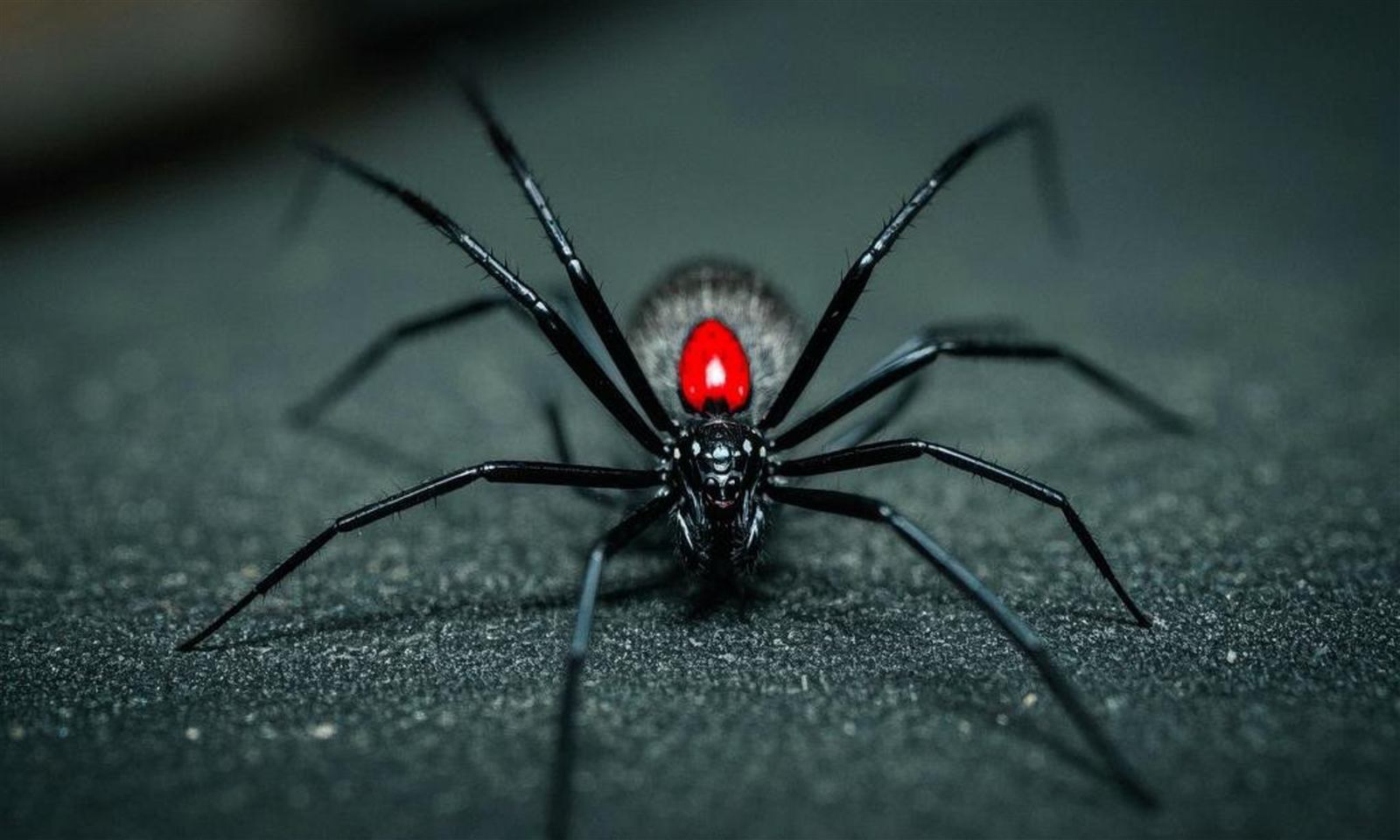
Black widow spider identification starts with two clear features: a shiny, jet-black body and a red hourglass-shaped marking on the underside of the abdomen. Unlike the brown recluse, which gets far more attention than its actual presence in Southern California warrants, black widows are genuinely common around Riverside properties, and a confirmed sighting deserves to be taken seriously rather than dismissed. Because spider control only works when the right species is identified, knowing exactly what a black widow looks like, where it tends to hide, and what a bite actually does is worth understanding before a professional ever needs to get involved. Here is how to identify a black widow with confidence, what happens if a bite occurs, where these spiders typically set up around a Southern California property, and when their activity tends to be most noticeable throughout the year.
How to Identify a Black Widow With Confidence
A mature female black widow, the sex responsible for the vast majority of confirmed bites, has a shiny, deep black body with a distinctive red hourglass-shaped marking on the underside of her abdomen. This combination, glossy black plus a red hourglass, is one of the more reliable and easy-to-confirm markings in the spider world, which sets black widows apart from many other species that require closer inspection or specialized knowledge to identify with confidence.
Male black widows are rarely the source of confusion in identification, mostly because they’re encountered far less often and don’t build the same prominent webs females do. Most identification questions center on females, juveniles, or spiders that only partially resemble the classic markings, which is exactly the gray area where a professional opinion is worth more than an online photo comparison.
Females are considerably larger than males, with a body roughly the size of a large pea, not counting the legs, and males are smaller, lighter in color, and rarely responsible for bites. Juvenile black widows can look quite different from adults, often with additional white or beige markings on the abdomen that fade as the spider matures, which occasionally causes confusion when a young spider doesn’t yet show the classic solid black and red hourglass combination associated with the species.
The hourglass marking itself is worth a closer look, since its exact shape and completeness can vary somewhat between individual spiders. Some females show a complete, well-defined hourglass, while others have a more broken or partial version of the marking. Regardless of how complete the hourglass appears, the combination of a shiny black body with any red marking on the underside of the abdomen is enough to warrant treating the spider as a likely black widow rather than assuming it’s something more benign based on an incomplete pattern.
Where Black Widows Typically Hide Around a Property
Black widows build irregular, tangled webs, distinctly different from the neat, symmetrical webs many other spiders spin, and they strongly favor low, undisturbed, dark locations close to the ground. Woodpiles are a classic hiding spot, both inside the gaps between logs and underneath a stack that hasn’t been moved in a while. Garages, particularly cluttered corners, storage boxes, and gaps behind items stacked against a wall, offer the same kind of undisturbed conditions black widows prefer.
Meter boxes, irrigation valve covers, and other small enclosed utility fixtures around the exterior of a property are frequently overlooked hiding spots, since they combine darkness, minimal disturbance, and proximity to the ground, all conditions a black widow finds attractive. Patio furniture that stays covered for extended periods, gaps in retaining walls, and the undersides of outdoor equipment left in one place for a long stretch round out the list of common locations a technician checks first during a spider inspection.
Storage sheds and detached garages deserve particular attention, since they tend to combine every condition a black widow looks for in one place: minimal foot traffic, stacked boxes and equipment creating dark crevices, and infrequent cleaning compared to a main living space. A property owner reorganizing a shed or storage area after months of inactivity is exactly the scenario where an unexpected black widow encounter tends to happen, since disturbing a long-undisturbed area is often the first contact a homeowner has with a web that’s been there for some time.
Found a Spider You Suspect Is a Black Widow?
Get a free inspection for a confident identification and a real treatment plan.
Request a Free Inspection »What a Black Widow Bite Actually Does
Black widows are considered one of the most venomous spiders in North America, and their bites can cause a range of symptoms depending on the amount of venom injected and an individual’s sensitivity. Common effects include localized pain at the bite site that can spread to nearby muscle groups, muscle cramping and rigidity, and in more significant cases, nausea and respiratory difficulty. Symptoms typically develop within the first hour or so after a bite, though the severity varies considerably from one case to another.
Because reactions can range from mild to serious, and because it isn’t possible to know in advance how a specific individual will respond, any suspected black widow bite deserves medical attention rather than a wait-and-see approach at home. Bringing the spider along for identification, if it can be safely captured, can help a medical provider confirm the species, though treatment for the symptoms doesn’t necessarily require positive identification of the spider itself.
Children, older adults, and anyone with underlying health conditions may experience more pronounced symptoms from a black widow bite than a healthy adult would, which is another reason a cautious approach makes sense regardless of how mild the initial reaction seems. Symptoms occasionally take a little time to fully develop, so a bite that seems minor in the first few minutes shouldn’t automatically be assumed to stay that way without some observation.
Why This Species Deserves More Attention Than Its Reputation Suggests
Black widows don’t carry quite the same cultural notoriety as the brown recluse, largely because the brown recluse’s necrotic wound imagery has become more widely recognized in popular culture. In terms of actual regional presence, though, black widows are the spider Southern California homeowners are far more likely to genuinely encounter, and their venom is medically significant enough that a confirmed sighting is worth acting on rather than dismissing as just another garage spider.
This is part of why correct identification matters so much in spider control generally. A homeowner who has learned to recognize the shiny black body and red hourglass marking is equipped to respond appropriately, whether that means giving the spider a wide berth and calling a professional, or confirming that what they actually found was a much less concerning species like a common house spider or a wolf spider, both of which get mistaken for black widows more often than people realize.
Wolf spiders in particular cause a fair amount of unnecessary alarm, since they’re large, fast-moving, and can look intimidating at a glance, but they lack the hourglass marking and pose far less risk than a genuine black widow. A quick check for the red hourglass is usually enough to rule a wolf spider out immediately, which is a useful piece of knowledge for anyone who wants to avoid an unnecessary panic over a spider that, while unwelcome, isn’t medically significant.
When Black Widow Activity Tends to Increase
Black widow activity in Southern California tends to pick up during the warmer months, as spiders that overwintered in sheltered spots become more active and juvenile spiders from earlier broods mature into adults capable of building their own webs. This doesn’t mean black widows disappear entirely during cooler months, since a mild Southern California winter rarely gets cold enough to eliminate an established population, but sightings and web-building activity do tend to increase noticeably as temperatures climb.
This seasonal pattern is worth keeping in mind for a property with a history of black widow activity in previous years. A cleared woodpile or a garage corner that has been previously treated is still worth a periodic check as the weather warms, since new spiders can move into a previously cleared spot faster than a homeowner might expect, particularly if the underlying conditions, clutter, undisturbed corners, minimal foot traffic, haven’t changed.
Egg sacs are another detail worth watching for during warmer months. A female black widow can produce several egg sacs over a season, each containing dozens of spiderlings, and an unaddressed egg sac near a woodpile or storage area represents a meaningfully larger future population than a single adult spider does on its own. Spotting and removing egg sacs during a routine inspection is part of why professional spider control tends to hold up better over a full season than a single spot treatment aimed only at visible adult spiders.
None of this means every black widow sighting requires a full-scale response. A single spider found and removed from an easily accessible spot is a different situation than an established web population with multiple egg sacs tucked into a woodpile that’s been sitting untouched for a season. The right response scales with what’s actually found, which is exactly why an inspection, rather than a guess based on one sighting, is the more useful next step for a property with a suspected black widow problem.
How Akela Approaches Spider Control
Our technicians identify the species actually present on a property before recommending treatment, since spider control that starts with an accurate ID holds up far better than a generic perimeter spray. Whether it’s a black widow population near a woodpile or a cluster of less concerning spiders drawn to exterior lighting, every treatment plan addresses the conditions actually drawing spiders in, alongside targeted treatment using eco-friendly, family- and pet-safe products where it’s genuinely needed. Every estimate is free, and there are no contracts required, ever. Egg sacs and webbing get cleared as part of a thorough visit, not just the adult spiders visible at the time of the appointment.
Because black widows favor the same cluttered, undisturbed conditions that can also harbor other pests, a spider-focused inspection is a useful opportunity to check for rodent activity in the same garage corners and storage areas, since both pests are drawn to similar low-traffic, undisturbed conditions around a property. Addressing both during a single visit tends to save a property owner from scheduling separate appointments for what often turns out to be related clutter and moisture conditions.
See Our Full Spider Control Services
Get a free estimate and a confident identification of what’s actually on your property.
See Spider Control »Black widows are common enough in this region that every homeowner benefits from knowing exactly what to look for: a shiny black body, a red hourglass marking, and an irregular web built low to the ground in an undisturbed spot. Taking a confirmed sighting seriously, and knowing when a bite calls for medical attention, is what actually keeps a black widow encounter from turning into something worse.
Frequently Asked Questions
How do I know if a spider is actually a black widow?
Look for a shiny, jet-black body and a red hourglass-shaped marking on the underside of the abdomen. This combination is distinctive and one of the more reliable spider markings to identify with confidence.
What does a black widow bite actually feel like?
Symptoms can include localized pain that spreads to nearby muscles, cramping, rigidity, and in more serious cases nausea and respiratory difficulty. Severity varies by individual, which is why any suspected bite should get medical attention.
Where do black widows typically hide around a home?
Common spots include woodpiles, garage clutter, meter boxes, irrigation valve covers, and covered patio furniture, anywhere low, dark, and undisturbed for extended periods.
Are black widows more dangerous than brown recluse spiders?
Both are medically significant, but black widows are considerably more common in Southern California than brown recluses, which makes them the species homeowners here are actually more likely to encounter and should take seriously.
Does black widow activity change with the seasons?
Yes. Activity tends to increase during warmer months as overwintering spiders become more active and juveniles mature, though a mild Southern California winter rarely eliminates an established population entirely.